23/08/16: Hadley Freeman – Life Moves Pretty Fast: The Lessons We Learned from Eighties Movies (and Why We Don't Learn Them from Movies Any More) (2015)

Hadley Freeman sees the 1980s as an unheralded golden era of film. Much of the appeal of this book is that it falls somewhere between a chatty, journalistic style of writing and a serious work of film studies. In the interesting introduction, she argues that since the big corporate buy-outs of the studios, film-making has become more formulaic and conservative, with few strong roles for women. I'm not entirely convinced by this. What about Sandra Bullock in Gravity? What about Jennifer Lawrence in The Silver Linings Playbook and The Hunger Games? She also uses the example of the Star Wars prequels being far worse than the 1977–83 originals, which they were, but 2015's Star Wars Episode VII is both a great film and one with a strong female lead. OK, this came out after the book was published, but it does suggest flaws in her theory. I think it's more the case that there have always been great and terrible films made in every decade. But it was good to read a positive reassessment of the 1980s, and I agree with most of her critiques of the films themselves. It’s hard to disagree with her observation that films are now designed to work internationally: nuanced dialogue doesn't translate in the way that helicopter explosions do.

One thing that didn't work so well was her top 10s. These seemed quickly and carelessly thrown together after the well-argued chapters. For example, some of the songs in her top 10 power ballads aren't even power ballads, while she overlooks a song such as Berlin's "Take My Breath Away", which was. Otherwise, an excellent book.

17/08/16: Sam Knee – Classic Rock T-shirts: Over 400 Vintage Tees from the '70s and '80s (2011)

Worth knowing that this is an abridged version of the 2006 book Vintage T-shirts: 500 Authentic Tees from the '70s and '80s. So this edition has fewer shirts. Perhaps it's that cutting-down process that explains the slightly arbitrary-seeming selection. Some silly errors could have been avoided. Metallica's Ride the Lightning is spelled as Ride the Lightening twice, despite the correct title being shown in the picture of the shirt itself. Also, a David Bowie T-shirt is captioned as being from the Station to Station era (1976), but clearly shows the Young Americans (1975) cover image. Despite that, the pictures of old T-shirts are fascinating, and the interviews with a handful of collectors are fairly entertaining. I would have liked more of the latter, and more detailed Q&As, as this extra context enriches the selection of photos. Those comments aside, this book is a pleasure to flick through and well worth a look.

21/07/16: Emma Donoghue – Room (2010)

Jack, aged five, is imprisoned in a single room with his mother, who was kidnapped seven years ago. This room is Jack's entire world, and it has become a sealed universe of play and learning. His mother protects him from the true horror of their situation. The things and places he sees on TV he believes are all unreal. Reality is the room alone. The book is narrated by Jack and through his impressions we learn how abusively they are being treated by “Old Nick”, their captor. It's overwhelmingly sad – especially since Jack demands so little beyond the love of his mother. You find yourself desperately hoping they will be rescued or escape, but wondering what sort of life Jack might have in a world he cannot believe or understand. Without wanting to spoil the ending, there’s a lot more to it than just getting out of Room… There are many negative reviews of this book on Amazon (partly because it was shortlisted for the Booker Prize, which always attracts a backlash), so I thought it was worth addressing some of the criticisms raised:

Nothing happens.”/“It’s dull.”: This is untrue. Plenty happens. During this novel, Jack and his mother live through the pivotal moments of their life, then have their world turned upside down again and again. The book is centred in Jack's interior consciousness, yes, but that world is going through daily transformation. This is hardly uneventful. I found it riveting – almost painfully so, as I was rooting for the characters so much and so touched by their love for each other.

Its depressing and/or upsetting.: Books about imprisonment and child cruelty are likely to be disturbing. But the true theme of this novel is compassion. The author wisely keeps the love of mother and son at the centre of the story, rather than merely turning it into a thriller. The disturbing elements are integral and necessary, hardly gratuitous.

Jacks voice is unrealistic.: Unrealistic compared to what? He’s not meant to be a typical five-year-old. He's a child whose very existence has been entirely shaped by his situation. He is highly advanced in some ways and extremely limited in others. I found this a heartbreakingly believable expression of his confinement, his insular life and his uniquely intense relationship with his mother – the only human he had ever known. This material makes for one of the most powerful novels I have read. Don't be put off by the horrible cover.

In 2015, Room was made into an excellent film.

16/07/16: Juliana Buhring – This Road I Ride: My Incredible Journey from Novice to Fastest Woman to Cycle the Globe (2016)

"If you really want to experience the world, get on a bicycle."

I'm wary of any book described as "inspirational", but this one genuinely is. Juliana Buhring survived a childhood in a religious cult and then the death of the man she loved. She decided to cycle around the globe, and set a world record in the process. This narrative details that trip. Her writing is wise, dry and funny. But there's also a perfect economy to the style: no filler, no trying to be clever-clever, no travel-writing cliché – just the bare bones of each diary entry describing the scenes she experienced.

Along the way there are moments of total despair – high winds, freezing cold and steep mountains that go up forever. There's awful discomfort – from severe food poisoning to being splattered in roadside human excrement during the Indian typhoon. And there's danger – being attacked by magpies in Australia, being mobbed by "hordes of silent, staring men" in India and being chased by a pack of wild dogs in Turkey ("terror-inspiring lions"). This is all in addition to the tiresome punctures and daily exhaustion that she has to deal with. There are also moments of freedom and joy, when she's totally at one with the world and herself. There's a lot of life wisdom and common-sense philosophy, but she never becomes preachy. The complete lack of ego is admirable and refreshing.

This is a highly readable, life-enriching memoir. I hope she writes another book about her ongoing adventures in cycling and beyond.

03/07/16: Brix Smith Start – The Rise, The Fall, and The Rise (2016)

I came to this as a Fall fan. The two sections (1983–88 and 1994–96) dealing with her two stints in the band make for fascinating reading, with a lot of insights into the creative process that made the group so dynamic on record and in concert. Of course it all ends in a horrible sordid m.e.ss. What surprised me is how very readable the rest of the book is: her young life split between Chicago and L.A.; her problematic relationships with her father; her issues with food; her relationship with violinist Nigel Kennedy; her friendship with Susanna Hoffs of The Bangles; her time on TV with Gok Wan (who doesn't come across as very nice); bouts of severe depression; opening Start, the Shoreditch fashion boutique, with her husband Philip Start; and ultimately recovering her love of music as Brix and The Extricated. I got hooked and by the last 200 pages couldn't put it down. Recommended.

On 14 June 2016, I met Brix at an event at Cafe Oto, Dalston, where she was interviewed by Thurston Moore and played an acoustic "Hotel Bloedel". She was very charming indeed and signed the book for me.

27/05/16: Alain de Botton – Essays in Love (1993)

Don't be put off by the title: this does not consist of essays. It's a first-person love story, presented as fiction, which takes a philosophical look at every stage of a relationship. The author details his chance meeting with Chloe on a plane, how they become a couple, fall in love and so on. He is excellent at the tiny details of relationships and what they tell us about ourselves. Anyone who is in – or has been in – a relationship will recognise parts of their own experience here. How do you say "I love you" without resorting to cliché? What do you do if you hate the new shoes your partner loves? How much of your inner self will your partner ever really know? He gives all this near-forensic analysis without ruining what is also a page-turning love story. One to savour.

20/05/16: Penelope Lively – According to Mark (1984)

Shortlisted for the Booker Prize in 1984, According to Mark follows writer Mark Lamming as he tries to research a literary biography. His research into the unsung author Gilbert Strong gets him involved with Strong's granddaughter, who runs a garden centre in Dorset, sparking off a series of events that culminate in a road trip through France.

This is another hugely intelligent, entertaining Penelope Lively novel. It's funny in places and contains gems of social observation. Particularly well drawn characters – such as Mark's controlling and super-controlled wife Diana – make this a real pleasure to read. Lively flits between perspectives, sometimes approaching a scene from an unexpected point of view and sometimes revisiting the same events to give another person's take on them. This is unusual and refreshing: so much fiction takes a more static line on whose perspective a book is from. She makes it work very freely and accessibly.

The book asks some deep questions about identity. It can also be read as a straightforward novel about human relationships. I came to this soon after the more serious Booker-winning Moon Tiger and was not disappointed.

14/05/16: Davy Rothbart – Found: The Best Lost, Tossed, and Forgotten Items from Around the World (2004)


The idea is great: people send in curious things they found in the street, from love letters to random-seeming notes. All human life is here – disturbing, funny, angry, sometimes poignant. What lets it down is the design, which blurs the distinction between the found item and its presentation. The labels of who found what and where get mixed in with the items themselves. Plus, it's not always clear where one find ends and another begins, so it feels artificially "arranged" and "designed". With a slightly more logical, documentary-style layout, this could have been one of the greatest books ever. Instead, the self-consciously "fanzine-y" feel never quite lets the humanity of the found items live and breathe. That's a shame, as there is some incredible material here.

13/05/16: David Cavanagh – Good Night and Good Riddance: How Thirty-Five Years of John Peel Helped to Shape Modern Life (2015)

A wonderful book. It's such a brilliant idea that you wonder why no one else thought of it. Cavanagh listens to John Peel radio shows across the decades and writes about them. It works as a history of Peel, a history of music and a history of British life in the 1960s, 1970s, 1980s, 1990s and early 2000s.

Two minor criticisms:

1. I would have much preferred complete tracklistings rather than the incomplete lists of artists played, but perhaps the full data of every artist and song name wasn't available. Or perhaps it would have taken up too much space.

2. It's a shame that the 1989 Hillsborough show wasn't discussed. Peel's heartbroken broadcast just after the disaster was a distressing, hugely emotional show and one I will never forget. You don't expect to hear your lifelong hero so consumed by grief that he can barely speak. Maybe Cavanagh regarded it as voyeuristic or exploitative to discuss Peel at such an emotionally vulnerable moment, and he'd probably be right, but the book reads a little as though this key event never happened (even though it's later mentioned in the news snapshots that opens each mini-section).

Those points aside, this is pretty much the perfect book and one I will read again (and again). Cavanagh writes so well about the artists Peel played, the evolving musical scenes they were part of (particularly punk and its aftermath), and about Peel himself, totally capturing the spirit and wit of the man.

It's also worth pointing out that the opening chapter is the best single piece of writing anywhere about the importance and legacy of John Peel. If you have any doubts about the influence of this legendary DJ, just read these 28 pages.

14/04/16: Dorothy L. Hughes – In a Lonely Place (1947)

Absolutely wonderful. A hardboiled crime novel written from an unusual perspective. It's hard to say much about it without giving away the plot, but the author sustains the tension brilliantly across 186 pages. Hughes makes you empathise closely with the characters, so this ends up being as much a tragedy as a mystery. It has much of the atmosphere of Raymond Chandler, etc, but with an additional emotional quality.

08/04/16: Mario Benedetti – The Truce: The Diary of Martín Santomé (1960)


I’m not sure if it's because of the translation to English or if this was true of the original Spanish text, but there's something slightly awkward about the writing. In a way, this works to highlight the awkwardness of the social setting – a middle-aged accountant falls for a colleague half his age. The author explores that situation in a reasonably compelling manner. The novel takes the form of a diary, and that definitely adds readability.


The one element that doesn't quite ring true is that the narrator is aged 49 (then turns 50), but the book is preoccupied with his retirement and old age. Maybe things were very different when this was published (1960), but 49 doesn't seem old enough for him to feel and act the way he does about his age. That aside, it's a moving story that offers insights into what it means to work, live and love.

05/04/16: Lawrence Block – Hit Me (2012)

Five unrelated stories presented as a novel. Some reviewers disliked that approach, but I'm not sure it matters: each story quickly hooks you in and it's all written beautifully.

Much of the brilliance of this book comes from the juxtaposition of a ruthless killer also being a stamp collector – the two aspects of Keller's life somehow working together. There are funny and disturbing moments: just as you think it's about to get cosy, the book shocks you again. Block is excellent at moral ambiguity, making you somehow sympathise with Keller the hired killer.

If there's a flaw it's that Keller's wife (Julia) seems too good to be true: not only does she tolerate his "work", but she also finds it makes him more attractive, which doesn't quite ring true. Other than that, Hit Me is hard to fault.

28/03/16: Penelope Lively – Moon Tiger (1987)

What a great novel. Claudia Hampton, now a 76-year-old woman, lays dying in her hospital bed. She recalls episodes of her history (sometimes dovetailing with world history) and the people she shared it with – her daughter, her brother, her partner and the true love of her life, killed in action in World War II. As fragments of memory drift in and out of focus, the story of her life emerges in patchwork form. It's a very satisfying approach. Although the perceptions are fundamentally Claudia's, the author also allows us inside the minds of the other characters for a more multilayered texture. There's a huge intelligence to the writing and it's a joy to read something of this quality and richness. One of the most enjoyable of the Booker Prize novels (it won in 1987), this is a book that stays with you.

19/03/16: Matt Lewis – Last Man Off: A True Story of Disaster, Survival and One Man's Ultimate Test (2015)


A riveting true story of a fishing ship, the Sudur Havid, which sank in the icy waters of the South Atlantic in 1998. Only 21 of the 38 crew survived, although when you read about what happened it seems miraculous that even they lived. The author relays the facts in a non-judgemental manner and comes across as a good-natured, practical young man who was thrown into an absurd and terrifying situation.

It's painful to read the catalogue of mistakes that led up to the disaster. The ship was old and poorly equipped. There was a lack of safety measures and procedures. The lifejackets were stored in lockers for which only one man had a key. And, most fatally, there was a misguided decision to keep on fishing through the storm even when the craft – already overloaded – started taking on water. Even the attempts to escape via life-rafts were chaotically disorganised.

The book has photos from beforehand and afterwards, but none are from the voyage in question. All cameras were lost with the vessel.

A gripping account, it is horrifying in places and hard to stop reading. It is a book that reminds you how lucky you are to be alive.

02/03/16: Lawrence Block – The Burglar Who Counted the Spoons (2013)

This 11th Bernie Rhodenbarr novel is a joy. The unlikely plot deals with spoons and buttons, theft and murder, but the main reason to read it is for the extremely dry, very funny dialogue. Block really has an ear for the way people talk. The gentleman burglar's conversations are full of literary references, little linguistic puns and hilarious observations. It's such a rich mix that you can just sit back and enjoy the way the sentences unfold.

It's also recommended to anyone who loves old bookshops and who despairs of the day when there are no more. I now want to read the previous 10 volumes...

21/02/16: Lawrence Block – The Girl with the Deep Blue Eyes (2015)

"Murder was easy. The tricky part was getting away with it."

The first Lawrence Block I have read, and I am hugely impressed. This is a disturbing tale that is absolutely riveting. It's dry, wry and funny in places, and heart-stopping in others. Private eye Doak Miller plots with Lisa (the blue-eyed girl of the title) to murder her wealthy, violent husband. It's morally all over the place, so that you don't know the good guys from the bad guys – or even if there are any good guys. It asks some fairly sinister questions about human behaviour as the plot takes the main character – and the reader – to some dark places. Be prepared to be shocked. A cliché, I know, but it's genuinely hard to put down. I had to keep on reading, hooked and horrified, to learn how this novel panned out.

18/02/16: Gore Vidal – Thieves Fall Out by Gore Vidal (1953)

Hugely enjoyable crime thriller set in Egypt at the time of the 1952 revolution and published under the pseudonym Cameron Kay. This is a quick read and certainly not intended to be a "great work of literature". It does not need to be: as a hardboiled pulp novel, it's brilliantly done. The plot races along. You get mysterious, glamorous women, dangerous gangsters, smuggling and political intrigue. As other reviewers have pointed out, there's rather too much attention to racial attributes when describing characters. That gripe aside, this is a fun, dynamic romp of a tale that you can devour in a couple of sittings.

12/01/16: Crystal Zevon (ed.) – I’ll Sleep When I'm Dead: The Dirty Life and Times of Warren Zevon (2007)

A fascinating oral history told in subtly interwoven recollections by Warren Zevon's friends, girlfriends, family and professional associates. He emerges as a deeply troubled character – at various points an alcoholic, wife-beater and womaniser. These issues are further complicated by his severe OCD and superstition. It's not a pretty picture that emerges, but before his death Zevon had apparently given his blessing that this full, unvarnished story of his life should be told.

If there's a criticism, it's that there's not enough detail about the music. You hear of his records being made, but because this story is told by others there is very little about the writing of the songs or how it felt to play them. The book does, however, include snippets from Zevon's own diaries – sometimes extremely personal, as when relaying intimate details of his affairs with various girlfriends (the addiction that replaced his addiction to alcohol). If you are prepared for the harrowing reality, this is a must-read book. It might not make you like this complex and brilliant man, but it will help you to understand him a little better.

27/12/15: Richard Flanagan – The Narrow Road to the Deep North (2013)

The Narrow Road to the Deep North is the story of a surgeon who endures time in a Japanese PoW camp in WWII, helping to oversee the brutal construction of the "Burma Death Railway". He's a complex man who becomes regarded as a great hero almost despite himself. The narrative moves forwards and backwards in time, telescoping the years brilliantly, examining how the defining relationship of his life changes everything that follows. The book works on multiple levels. It's especially good at conveying the utter wretchedness of life in the PoW camp – the insane cruelty that somehow became ordinary routine. It takes an elegiac tone as it follows up on various lives after the war ended, showing that for many of the individuals scarred by these experiences it never really ended at all.

It's a deep book that takes some getting into – moving slowly in places and then racing through the years in other sections. It's a wise book, too, understanding that the moral choices we make are never simple.

As a work of literary construction it's impressive. It won the won the 2014 Booker Prize and you can see why. It's not "difficult", by any means (although you might want to look away during some scenes of brutality), but it's rich enough that you would probably get more out of it on a second reading.

13/12/15: Jacques Bonnet – Phantoms on the Bookshelves (2010)

Fascinating reflection on the joys – and challenges – of owning a huge collection of books. The minutiae of how to file them is examined with joyous detail. If you love your books (rather than soulless electronic "files"), and find it hard to part with them, this is a stimulating and inspiring read. The only gripe is that there's not more of it. After 123 pages, you wish for additional collector-obsessive detail.

10/12/15: Norman Collins – London Belongs to Me (1945)

Superb, sprawling saga about the residents of no.10 Dulcimer Street, Kennington, London, with England in the shadow of World War II. In particular the focus is on Mr and Mrs Josser and their family, who form the emotional core of this mini-community. We also meet their landlady Mrs Vizzard, the well-meaning petty criminal Percy, the ravingly politicised Uncle Henry and the devious "spiritualist" Mr Swales. There’s also flamboyant nightclub attendant Connie and food-loving Mr Puddy. The book follows the lives of each character, circa 1938–1940, interweaving the strands brilliantly with both comic and serious moments.

In Ed Glinert's introduction to the Penguin Modern Classics edition, there’s an almost apologetic note about this not being a “complex, sophisticated novel” (i.e., a “serious” work of literary fiction). “It exists simply as soap opera,” he writes. This sells it short. Yes, it’s unashamedly populist and very easy to read, but that’s not to say it’s in any way shallow or formulaic. Far from it: over 830 pages, Norman Collins weaves a huge tapestry that continues to surprise and delight. A huge range of life and experience is presented here and the human truths the author explores are no less relevant now than when this was first published in 1945.

Note: a film, a.k.a. Dulcimer Street, was made in 1948 (featuring Richard Attenborough and Alastair Sim) with significantly altered plot elements.

17/10/15: Nicholson Baker – Traveling Sprinkler (2013)

An amiable sequel to The Anthologist, switching the musings on writing poetry to musings on writing songs. Much of the book involves descriptions of day-to-day life – smoking a cigar, driving the car, learning to use music software, trying to win back a girlfriend – and as a novel it's almost plotless, allowing you to focus on the narrator's voice and personality. It lacks the intense detail of his earlier writing style – those ultra-detailed digressions – but gains something in worldly wisdom. As with Kurt Vonnegut, his warm, wise voice is a pleasure to spend time with.

26/09/15: Jordan Belfort – Catching the Wolf of Wall Street: More Incredible True Stories of Fortunes, Schemes, Parties, and Prison (2009)

For some reason I assumed this sequel to The Wolf of Wall Street would be about Jordan Belfort's time in prison. In fact, he doesn't go to prison until the very end of this book. The bulk of it details his legal case, with lengthy recaps detailing how he came to be the Wolf in the first place. The lengthy recollections of his earlier life allow for further stories of excess, and also a strong sense of how he slowly develops and matures. There's also some moving writing about his growing relationship with his children, who come to symbolise hope for his (post-criminal) future.

At the end he talks about how reading Tom Wolfe's Bonfire of the Vanities helped him find his writing voice, and you can certainly see the influence – larger-than-life characters are often built up into nicknamed caricatures, from his second wife ("The Duchess") to his Russian girlfriend ("KGB"). Then there's "OCD", "Magnum", "The Witch" and so on.

If you liked the first book, you should find this every bit as enjoyable. He writes so well that he is entertaining and insightful whatever the subject matter.

26/07/15: Sergio De La Pava – A Naked Singularity (2008)

"Precision in language is the most critical of human endeavors."

I disagree with those critics who said this huge novel was in need of a strict editor. It's precisely the sprawl of it that appeals, allowing witty detours into everything from boxing to theology. Dazzling language and all sorts of philosophical thinking sit alongside the plot – successful young lawyer finally loses a case, plans perfect crime, and tries to save a man on death row. It's clever and funny, but warm too – not a cold postmodern experiment. The scenes with Casi's family are warm and moving. There's so much in it – such richness – that it's definitely a book that would be worth reading twice. The author delights in the use of language and the exploration of ideas. The dialogue is sparklingly witty. And what seem like digressions are arguably just as important as everything else.

A masterpiece.

24/05/15: Tim Parks – The Server a.k.a. Sex is Forbidden (2012)

An interesting and not-quite-great novel. The detail of the Buddhist retreat is well handled, and the complex character of Beth is well constructed. The title change was a bad decision: The Server works on several levels and it's a shame that this was replaced with something more tabloid-friendly for the paperback. The story is fairly minimal, but that isn't the point. It's really a book about identity: what makes us who we are? Although I enjoyed it a lot, I don't think it revealed the wit or intelligence of Europa, the novel that made me interested in Tim Parks. That said, I will definitely read more of his books.

13/05/15: Andy Miller – The Year of Reading Dangerously: How Fifty Great Books Saved My Life (2014)

The concept is good: an attempt to read 50 life-enhancing works and document that experience. The author does this in a highly readable manner and the book starts well. The first half covers the first 13 books in detail (as per his list on p.297). After that, something odd happens to the structure. He dedicates the second half to the remaining 37 books, but some of them barely get mentioned. Of course it's the author's right to structure the book however he likes, but it does feel imbalanced. Plus, this falsifies the "fifty great books" part of the project: you expect to read his thoughts on all 50 entries, not just a selection of them. I was looking forward to hearing how he related to On the Road, Catch-22, Lord of the Flies, Frankenstein and many other classics, but – confusingly – he ignores them completely.

Another issue is the tone of voice. Again, this becomes less satisfying as the book progresses. On p.201 he writes: "I did not join a book group to talk about my feelings. I wanted to talk about books: how they fit together, why they worked, the occasional miracle of fiction." So why, then, is so much of this book about his feelings rather than the books he read? There are countless personal digressions and too often he veers into chummy "blokey memoir" territory (see also Stuart Maconie, Mark Radcliffe, Andrew Collins) despite commenting at length on the "blokeishness I find disconcerting" in other men. Again, this confuses matters.

The Year of Reading Dangerously is at its best when the author writes in detail about the books themselves and what it feels like to read them – sometimes pleasurable, sometimes excruciatingly difficult, and sometimes both.

16/04/15: Dominic Cooper – The Dead of Winter (1975)


Set in the remote Scottish island village of Cragaig, this short novel has an elemental power that the author draws from his profound descriptions of weather and landscape. Fisherman Alasdair Mòr has hung on to a traditional way of life that has vanished around him, and seems content leading a solitary life in harmony with nature. Then a newcomer arrives and changes everything.

Cooper writes with real intensity. His descriptions of the sea and land are beautiful, but never merely decorative. It is a book that will stay with me.

05/04/15: Tim Parks – Europa (1997)

Booker Prize-shortlisted, Europa is a ferociously intelligent and witty novel. The brilliantly sustained first-person stream-of-consciousness narration comes from Jerry Marlow, who – struggling with a mid-life crisis of sorts – finds himself on a coach to Strasbourg with other Milan University staff (including a woman with whom he had recently had an intense affair) to petition the European Parliament about employment rights.

The characters are extremely well drawn. You can read this as political satire and/or as a study of excruciating human situations. I was sorry when it ended and am now keen to try out more by this author.

28/03/15: Carrie Fisher – Shockaholic (2011)

Considering all the electro-shock therapy she endured to combat depression (detailed, unflinchingly, in the first chapter), it's incredible how sharp and witty this (sort-of) memoir is. What a great writer. As with the previous book, Wishful Drinking, it details a series of episodes and recollections from Carrie Fisher's professional and personal life. It's far from a full, chronological memoir, and reading the reviews on Amazon, it seems many were disappointed by that brevity. I thought it worked well, as the prose is so rich with wit and anecdotes. There are chapters on her relationships with her father, her stepfather, her one-time stepmother Elizabeth Taylor and so on. There's a very insightful reflection on her friendship with Michael Jackson: she shows real understanding of his problems without taking the easy tabloid route of portraying him as either monster or saint.

The topic she keeps returning to is that of her father, and how she came to know him better in his final years. She recalls him with much humour and love, and never lets sentimentality get in the way of realism: her father was hardly ever there for her, but she adored him anyway. It's touching stuff.

15/03/15: Albert Cohen – Her Lover (Belle du Seigneur) (1968)

This is a novel of such richness that it is hard to describe. Across 974 pages Albert Cohen builds an astonishing creation. All human life and emotions are here, and yet the story is a simple one. There are many stream-of-consciousness passages in which you get one character's thoughts. There are no paragraphs in these sections, just a continuous flow of flitting ideas. Don't let this put you off: these passages are insightful indeed, and highly readable. Cohen is superb at capturing the way the restless mind works. There's also comedy in the antics of Solal's pompous but well-meaning uncles. And there's tragedy, too. He moves so well from the farcical to the profoundly poignant (and often back again). But at the core of this book is a study of the life-span of a relationship: attraction, seduction, obsessive love and what happens afterwards.

As soon as I finished the book, I wanted to start it all over again. It takes time to read, but it's worth the effort. In fact, the real story doesn't begin until about a third of the way in. Before this, there are brilliant satires on those in pursuit of upward mobility at the expense of all else, and a close look at what Alain de Botton called "status anxiety". The chapters dealing with Deume and his family are priceless: it was a surprise when these characters then dropped out of the novel. The use of language is dazzling, so full credit to David Coward for his translation from the original French text. This book resonates with truth. Bear with it and you will be rewarded with real glimpses into the human soul.

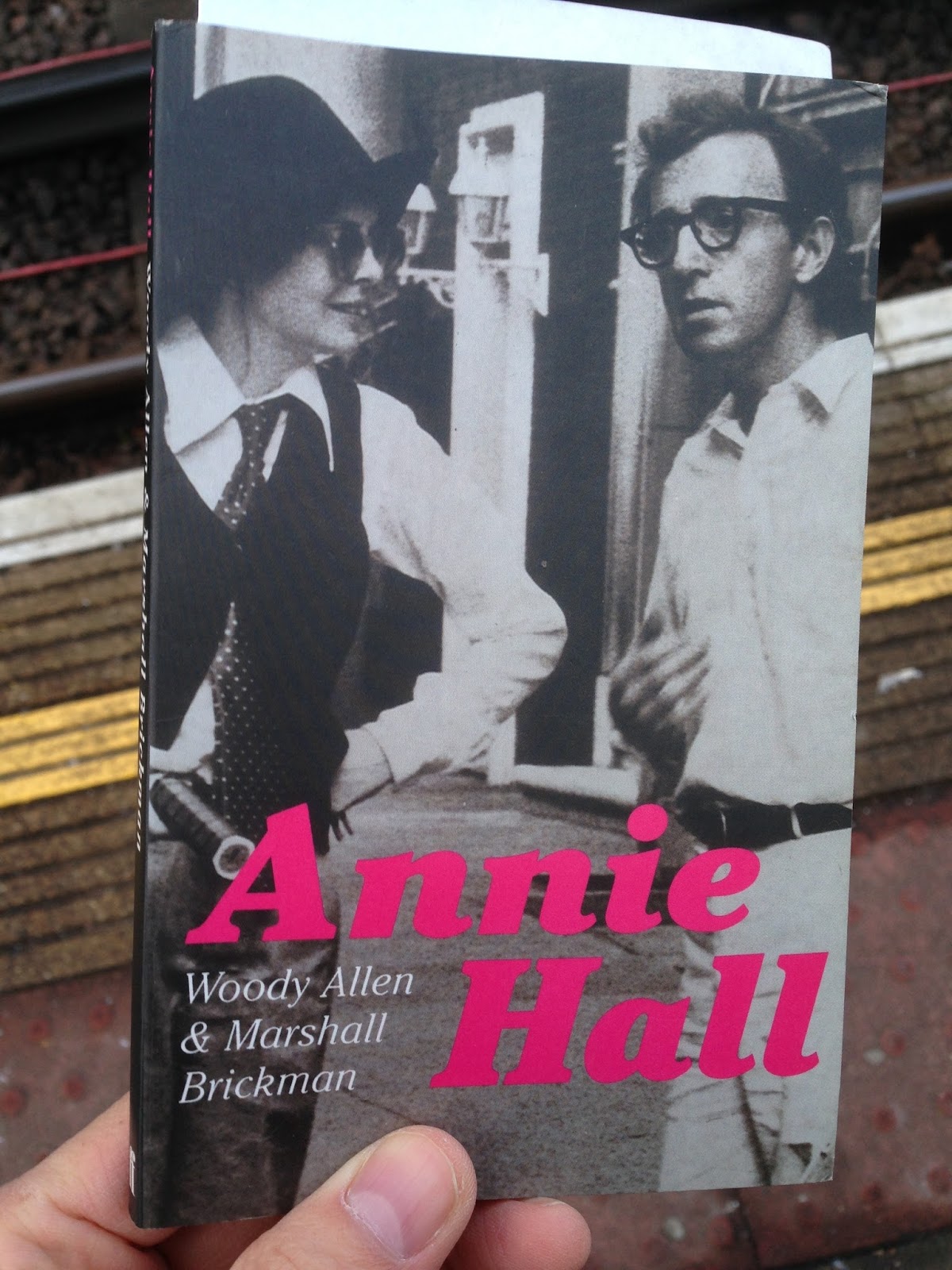
06/02/15: Woody Allen & Marshall Brickman – Annie Hall (1977)

Annie Hall is rightly regarded as a classic film. Such great acting. Such a great script. So many great lines. It's a joy to read them again here. You can really "hear" Woody Allen and Diane Keaton speaking the words. The story – a clever tale about the various stages of a relationship – has a universal, timeless element that transcends the topical references to 1970s USA. And it remains very, very funny.

29/12/14: Roger Green – Destination Nowhere: A South Mimms Motorway Service Station Diary (2004)

"I have a fifty-year-old woman sitting facing me, a few tables away. She is tucking into a large dish of quiche and assorted salad. Must have cost a bomb. Sunglasses rest on top of her ginger hair, her black blouse is unbuttoned halfway down, her large cleavage is prominent. She sits in a tight red skirt, with black stockings up to her bum, a pair of high-heel black shoes dangle off her toes . . . A man walking past in light brown desert boots and an all-in-one matching pilot's suit complete with coloured epaulettes catches her eye. He has Arab features – Colonel Gaddafi meets Marlene Dietrich!" (p.197)

A book of observations of the humdrum daily activities at South Mimms Motorway Services. Parts of it are dreary indeed – details of what people are wearing, eating and so on (as above) – and the author's prose fails to infuse the mundane with any sense of the extraordinary. The book is heavy on detail (including far too much about the author's use of the toilet cubicles), but light on analysis – an intentional approach, no doubt, but not one that's especially engaging. A more poetic writer observing this seething mass of humanity could have explored universal truths about who we are and how we live. More interesting are the brief interviews with service-station staff and regulars, who provide glimpses into the local history and real insights into the long hours spent in these non-places between places. More of this "oral history" tactic would have worked better.

A few errors: the group is The Byrds, not The Birds (p.32), and it's Pete Townshend, not Pete Townsend (p.148). The song referred to is "I'm a Believer", not "I am a Believer" (p.56), and slang for a bloke is "geezer", rather than "geyser" (p.67). These points may seem minor and/or pedantic, but they have an undermining effect: when he writes of "a young William Haigh type" (p.70), it's unclear whether he means the former Conservative party leader William Hague or someone else entirely. Not quite the level of research you'd expect from someone described as "Director of the Centre for Community Research at the University of Hertfordshire".

Some of the observations left a sour taste: "What is it about couples, men and women, walking arms around each other's waists so early in the morning? Have they just emerged from the Days Inn Motel opposite where a night of pleasure has occurred? Or is it simply they are sad people?" (p.149) What's wrong with being in love? Why is showing affection "sad"?

On the plus side, the photos are nice and I would have liked more of them. There's an entertaining and insightful book to be written about service stations. This isn't it.

28/12/14: Susanna Moore – In the Cut (1995)

A short, intense thriller: Frannie teaches linguistics in New York. She encounters a series of men, all of them potentially dangerous and one of them a brutal murderer. She becomes involved in an ambiguous relationship with the detective investigating the case and things start hotting up . . . An intelligent crime novel that quickly hooks you in. I am new to the author, but may well read more of her books based on the strength of this novel.

02/11/14: Chris Brook & Alan Goodrick – K Foundation Burn a Million Quid (2002)

In 1994, the K Foundation – Bill Drummond and Jimmy Cauty – travelled to the island of Jura, off Scotland, where they burned one million pounds in bank notes. Their friend Alan "Gimpo" Goodrick filmed them doing it. Bill and Jimmy then toured with the film, inviting debate about the meaning of the act. Was it art? Was it a political gesture? Was it stupid and reckless? Were they making a great statement? This book presents stills from Gimpo's film along with transcripts of these debates and other bits of commentary.

There are no "easy answers" about burning £1 million, but there's some very interesting discussion about the nature of art, money and value.

Note: although Bill Drummond has distributed this via his Penkiln Burn imprint – and obviously features heavily – this book is not written by him, as is suggested in some online listings.

24/10/14: Martin C. Strong – The Essential Rock Discography (2006)

It's obvious that a great deal of research went into this book, but it is badly let down by a few things:

This streamlined 2006 edition of what was once The Great Rock Discography no longer includes artists such as Gong, Talk Talk, Kirsty MacColl or even Abba, so it's much less comprehensive than you might have hoped, despite stretching across 1,250 pages. Yet space was somehow found for The Kaiser Chiefs, Kasabian, Keane, The Killers, The Kooks, Korn, Lenny Kravitz, and so on.

It's in desperate need of proof-reader:
• The commas and apostrophes are all over the place – for example: "you're answers please on the back of a postage stamp" (p.472), This Years Model (p.243), etc
• There are silly typos such as "the The Smiths" (p.996) and spelling errors such as "punk sterotypes" (p.388) and "Blur mainman Damon Alborn" (p.605)
• There are factual errors: Morrissey's book was called James Dean is Not Dead, not James Dean Isn't Dead (p.996). The Fall's Levitate album was released in September 1997, not February 1998 (p.393). And in the same entry, keyboard player Marcia Schofield has been renamed "Marsha Schofield" (p.390).
If these mistakes can be found on a first glance through the pages, then what else is incorrect? The usefulness of a reference work of this kind depends on you being able to trust the information it offers.

By the end of the book, the printing has gone askew. The last few pages have been sliced in such a way that text is right up against the edge of the page and very difficult to read. On p.1,153, the caption "Lou Reed of The Velvet Underground" is also sliced off midway through the text. It may just be my copy, of course, but I'd still suggest you check before buying.

The artist biographies are deliberately subjective and opinionated, which can be entertaining, but the excessive exclamation marks make some of the entries tiresome. And some are a little simplistic: there's way more to Nico than "an avante-garde, moody songstress" (p.757).

These might sound like fussy points, but after all the effort that went into compiling this it's a real shame that a potentially invaluable reference book is undermined by things that might easily have been fixed. Maybe the next edition?

29/09/14: Jason Bitner – Found Polaroids (2007)

Found Polaroids is an interesting anthology of pictures picked up and sent in to Found Magazine. Each left-hand page contains a brief caption: where the photo was found and perhaps a few thoughts about the origins or meaning of the image. The right-hand page is the photograph itself. The format is very simple and seems to have disappointed reviewers, but I found this to be a rewarding book. The best pictures are deeply mysterious: who are these people and places? Why were the polaroids taken and why were they later lost?

20/07/14: Peter Doggett – Jimi Hendrix: The Complete Guide to His Music (2004)

This 160-page book covers every known Hendrix release issued during his life, along with posthumous albums, and officially and semi-officially released material. It really gets into the detail and helps you pick through the vast maze of Jimi's discography. Last updated in 2004 it obviously misses any releases since then, but what you do get is comprehensive indeed.

The author comes across as informed rather than opinionated, and wisely chooses not to take sides with the various factions responsible for these releases. It's a shame that the song index wasn't expanded to include all of the albums as well, as it can be difficult to navigate. But this is still well worth reading.

17/07/14: Nicholson Baker – Room Temperature (1990)

Room Temperature may be the best example of Nicholson Baker's ultra-detailed prose. He takes an idea and lets it unfold, exploring the associated ideas that flow forth (logically and illogically) from it. It's a short book, and beautifully written. Don't expect a "plot". It all takes place in the organic drift of the narrator's thoughts one afternoon as he sits with his baby falling asleep. But in rendering consciousness so vividly, Baker achieves something very rare.

11/10/13: John Updike – Towards the End of Time (1997)

“White light knifes beneath the window shade a minute or two earlier each morning, in strict accordance with the planetary clockworks.”

This novel is set in 2020 after a war between China and the USA, where protagonist Ben Turnball remains wealthy despite a highly unstable economy and a breakdown of social order. That major element aside, it is still John Updike doing what he does best – tracking human relationships and perceptions with uncanny precision, and musing upon how it feels to grow older.

There are several odd "alternative reality" digressions in which Ben imagines/believes he is someone/somewhere else. I'm not entirely sure these work, but Updike seems to be exploring the idea that experience is subjective. This makes for interesting plot twists: for example, it's suggested at one point that Ben kills his wife, only for her to return later as if nothing had happened. The writing is clever, and always vivid and perceptive, so why was it less enjoyable than it should have been?

Perhaps because John Updike draws his characters with such brutal realism that they are impossible to like. Or perhaps the bleak world in which Ben lives seems stripped of meaning, just as the "oceans are as exhausted and mined-out as the land".

It's a fascinating book and one that will leave you feeling uneasy and possibly rather disturbed.

02/10/13: Carrie Fisher – Surrender the Pink (1990)

"I like to talk to you. I like you as a person."
"As opposed to what? An end table?"

This is a supremely witty and perceptive novel about relationships. Carrie Fisher really gets inside the characters' insecurities, and mines these for dark comedy. Some of the dialogue is like Woody Allen at his best – perfectly judged chatter that casually reveals great truths through its self-conscious rhythms. It's generally known that Carrie Fisher's fiction is highly autobiographical and so it's especially interesting to read this after her memoir Wishful Drinking. Star Wars fans may notice the sentence "She felt sad and caught. Caught in the tractor beam of her old obsession." Subconscious reference to the Death Star pulling in the Millennium Falcon or just a weird coincidence? Either way, what a great novel!

05/09/13: Mark Lawson – Going Out Live (2002)

Extremely witty satire about a broadcaster whose personal and professional life starts to fall apart. Being a BBC broadcaster himself, Lawson obviously knows his stuff and it's tempting to read this novel autobiographically. However, that would understate how creatively and imaginatively he takes this raw material and shapes it into a genuinely funny and insightful look at celebrity, the media and identity.

23/08/13: Michèle Roberts – Paper Houses: A Memoir of the '70s and Beyond (2007)

Not many books could contain all of these sentences:

1. "All my life as a writer I have loved the semicolon."

2. "I had seen Suzy Seven-Up in a bar on Patpong smoking seven cigarettes through her c*** at once: I showed Bertie that I could do the same."

3. "I was so terrified I shat my trousers."

4. "Goodness: I'd become a lesbian."

5. "I could watch the sunset melt into blue-grey night, pick out the coiled lazy snake of the motorway, creased and glittering with cars, the oblongs of tower-blocks pitted with gold. Above me, jets trailed jewels."

The author writes nicely, whether it's on the wonders of working as a librarian at the British Museum or detailing her various London flats and the people she shared them with, and there are some very evocative passages: "In summer, people kept their long fron windows open to the night, rectangles of gold releasing the hot clatter of jazz."

She takes herself very seriously – not necessarily a bad thing. As an insight into life in London in the 1970s, this is a fascinating and rewarding read.

11/08/13: Ian McEwan – On Chesil Beach (2007)

Edward Mayhew and Florence Ponting have just been married and are honeymooning in a hotel at Chesil Beach, Dorset, in 1962. But on their first night together they are separated by class and expectations, and the physical consummation that Edward so craves is repellent to Florence.

How this very English scenario plays out – and the events that led up to this evening, and those that lead away from it – are played out in McEwan's ultra-focused, almost clinically precise prose over 166 pages. It's compelling stuff.

09/08/13: James Bowen – A Street Cat Named Bob (2012)


Touching tale (tail?) of a recovering drug addict/homeless man who adopts a lost ginger tomcat, who in turn gives him a reason to live. James takes to busking with Bob by his side or on his shoulders, and his fortunes begin to improve. Later he sells the Big Issue and ultimately becomes a minor celebrity – hence this book. Along the way, there are scary episodes such as losing Bob in the crowded streets of central London, being treated with hostility or suspicion as one of society's marginal figures, and the harrowing cold turkey of getting off methadone.

Bob the cat emerges as a great character – strong-willed and intelligent, brave but vulnerable – and it's moving to read about the bond that builds up between man and animal. This inspiring book is also a reminder that we need to be kinder to sellers of the Big Issue: they don't get given their magazines, they have to buy them. They are urged to manage this responsibly as a mini-business, as this helps them scrape a living with dignity (in a way that charity hand-outs don't).

James Bowen was more fortunate than most because his furry friend often acted as a magnet for public goodwill (odd how we relate to animals more emotionally than we sometimes do to humans). So spare a thought for those without gorgeous pets to melt the hearts of passers-by and read this excellent book.

20/07/13: Wilton Barnhardt – Emma Who Saved My Life (1989)


Gil Freeman moves to New York City in the 1970s hoping to become an actor. He shares a flat with Lisa (who wants to paint) and Emma (who wants to write). Parts of this debut novel, such as the beach house visit and the first night of Gil's show, are very clever and very funny. The book is also about youth, friendship and ambition and what happens to them as time goes by. Each chapter is set a year later than the one before, enabling the author to reflect the mood of the moment (news reports re: Nixon and Reagan both figure in the background) and offer snapshots of key moments in the characters' lives. It's very entertaining and moving, too. After 470 pages I would have been happy for it to go on a lot longer.

20/06/13: Nicholson Baker – The Fermata (1994)


Like Nabokov's Lolita, this book draws deliberately uneasy comedy from moral ambiguity. Arno Strine can pause time yet move freely while all around him is frozen. He uses this "gift" to peek beneath clothing and explore other obsessive thoughts about women. It's very rude in places.

Told with wit and great intelligence, the novel both charms and disturbs. Baker isn't afraid to offend, and doesn't try to "justify" the ethical minefield of Arno Strine's actions, although he does explore the issues they raise. He is smart enough to let readers make up their own minds and urges them to consider how they would behave if they had the same ability to stop time.

A hugely thought-provoking novel, but possibly an acquired taste.

11/06/13: Caroline Paul – Lost Cat: A True Story of Love, Desperation, and GPS Technology (2013)


Cat owner uses GPS and other methods to spy on her pet's wanderings. Much of the humour in this short non-fiction work comes from the author satirising her own obsessive/possessive behaviour, which will ring true with many cat lovers. The book asks how a small, furry feline can turn its carer into a somewhat deranged jealous monster. Endearing drawings by Wendy MacNaughton add to its heartwarming qualities.

Also recommended in this little-explored genre is Ian Phillips' Lost: Lost and Found Posters from Around the World (2002) – an anthology of lost-pet posters retrieved from various locations. It's a touching book – you realise just how much some people love their pets. It's also surprisingly funny, as many of the pet owners have been very witty in creating their signs – both in terms of the wording they use on the poster and also the doodles and modified photos used to illustrate them. There's very little commentary beyond an introduction and the occasional explanatory caption, but there's a useful guide to making an effective lost-pet poster of your own, should the worst happen...

09/06/13: Ali Smith – The Accidental (2005)


A brilliant novel. A family takes in – and are taken in by – an uninvited guest, who goes on to change all their lives in different, profound ways. Ali Smith realises the value of ambiguity and deliberately doesn't over-explain motives. She leaves enough mystery so that the unfolding story – told from all five characters' points of view – stays fascinating throughout. There are some beautifully written passages, too, so parts of the book have a very special, almost dream-like atmosphere.

20/05/13: Ed Park – Personal Days (2008)


“People drop off the radar once they leave the office. Week after week you form these intense bonds without quite realizing it. All that time together adds up... You see co-workers more than you see your so-called friends, even more than you see your significant others, your spouses if you have them... We know each other well but only to a point.”

Dryly witty and well observed with definite similarities to Then We Came to the End by Joshua Ferris, but maybe that says more about the repetition of office life, which is examined so expertly in both books. As for the claims by reviewers that it's not funny enough, I would disagree. Like Then We Came to the End, Personal Days excels in a well-judged tone of tragicomedy based on sad-but-true reflections that make will perfect sense to office workers and indeed anyone who contemplates the small wonders and banalities of a working life.

13/05/13: Beryl Bainbridge – Injury Time (1977)


A very nicely observed slice of comedy and drama. Extremely well written, with amazingly perceptive observations about human relationships. The brilliant sideways turn in the plot (about halfway through) brings into even sharper focus the quirks and peculiarities of the great characters who have been so well established early on. It would make a great film or play.