
24/05/15: Tim Parks – The Server a.k.a. Sex is Forbidden (2012)

13/05/15: Andy Miller – The Year of Reading Dangerously: How Fifty Great Books Saved My Life (2014)

Another issue is the tone of voice. Again, this becomes less satisfying as the book progresses. On p.201 he writes: "I did not join a book group to talk about my feelings. I wanted to talk about books: how they fit together, why they worked, the occasional miracle of fiction." So why, then, is so much of this book about his feelings rather than the books he read? There are countless personal digressions and too often he veers into chummy "blokey memoir" territory (see also Stuart Maconie, Mark Radcliffe, Andrew Collins) despite commenting at length on the "blokeishness I find disconcerting" in other men. Again, this confuses matters.
The Year of Reading Dangerously is at its best when the author writes in detail about the books themselves and what it feels like to read them – sometimes pleasurable, sometimes excruciatingly difficult, and sometimes both.
16/04/15: Dominic Cooper – The Dead of Winter (1975)

Set in the remote Scottish island village of Cragaig, this short novel has an elemental power that the author draws from his profound descriptions of weather and landscape. Fisherman Alasdair Mòr has hung on to a traditional way of life that has vanished around him, and seems content leading a solitary life in harmony with nature. Then a newcomer arrives and changes everything.
Cooper writes with real intensity. His descriptions of the sea and land are beautiful, but never merely decorative. It is a book that will stay with me.
05/04/15: Tim Parks – Europa (1997)

The characters are extremely well drawn. You can read this as political satire and/or as a study of excruciating human situations. I was sorry when it ended and am now keen to try out more by this author.
28/03/15: Carrie Fisher – Shockaholic (2011)

The topic she keeps returning to is that of her father, and how she came to know him better in his final years. She recalls him with much humour and love, and never lets sentimentality get in the way of realism: her father was hardly ever there for her, but she adored him anyway. It's touching stuff.
15/03/15: Albert Cohen – Her Lover (Belle du Seigneur) (1968)

As soon as I finished the book, I wanted to start it all over again. It takes time to read, but it's worth the effort. In fact, the real story doesn't begin until about a third of the way in. Before this, there are brilliant satires on those in pursuit of upward mobility at the expense of all else, and a close look at what Alain de Botton called "status anxiety". The chapters dealing with Deume and his family are priceless: it was a surprise when these characters then dropped out of the novel. The use of language is dazzling, so full credit to David Coward for his translation from the original French text. This book resonates with truth. Bear with it and you will be rewarded with real glimpses into the human soul.
06/02/15: Woody Allen & Marshall Brickman – Annie Hall (1977)
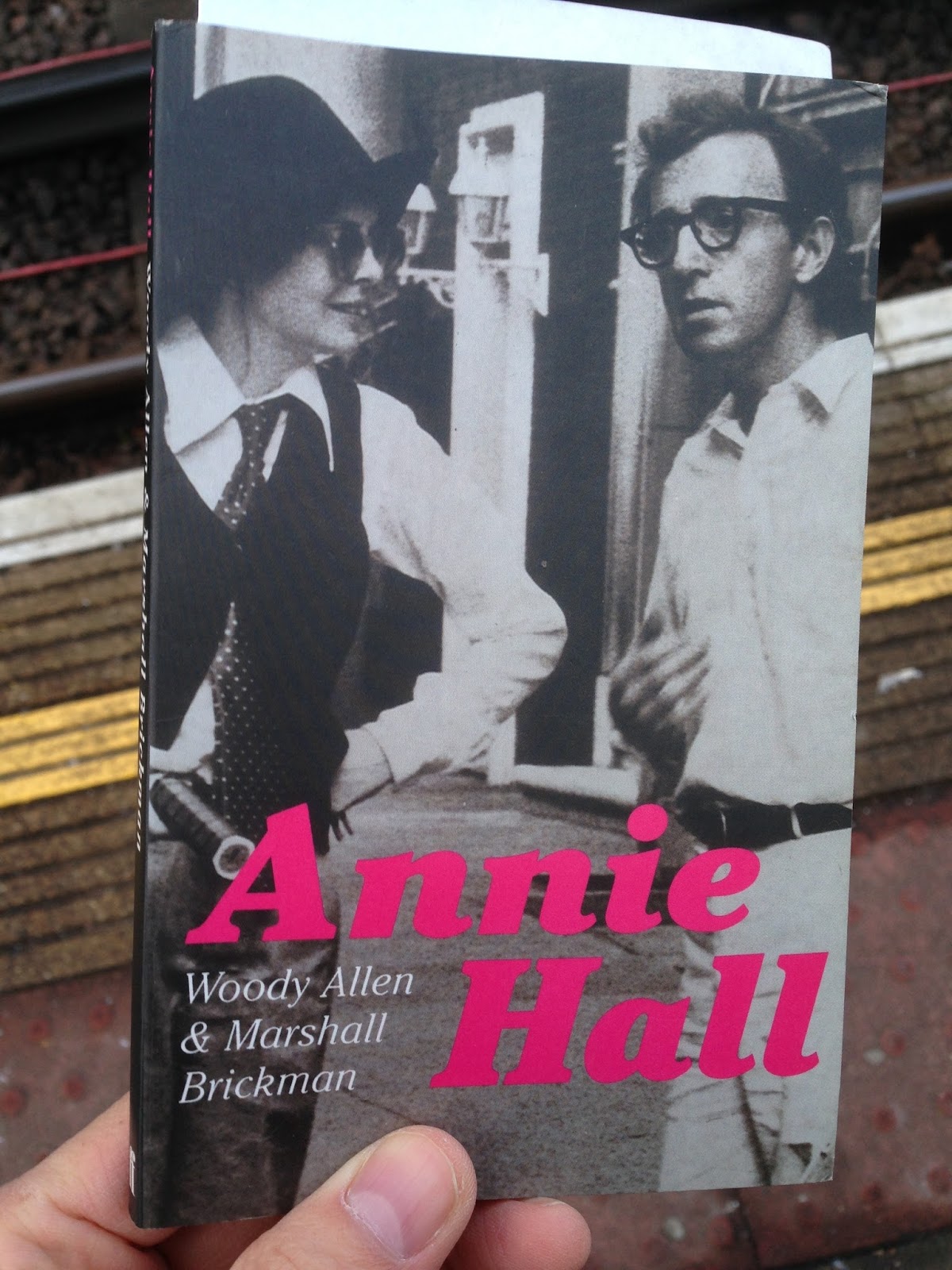
29/12/14: Roger Green – Destination Nowhere: A South Mimms Motorway Service Station Diary (2004)

A book of observations of the humdrum daily activities at South Mimms Motorway Services. Parts of it are dreary indeed – details of what people are wearing, eating and so on (as above) – and the author's prose fails to infuse the mundane with any sense of the extraordinary. The book is heavy on detail (including far too much about the author's use of the toilet cubicles), but light on analysis – an intentional approach, no doubt, but not one that's especially engaging. A more poetic writer observing this seething mass of humanity could have explored universal truths about who we are and how we live. More interesting are the brief interviews with service-station staff and regulars, who provide glimpses into the local history and real insights into the long hours spent in these non-places between places. More of this "oral history" tactic would have worked better.
A few errors: the group is The Byrds, not The Birds (p.32), and it's Pete Townshend, not Pete Townsend (p.148). The song referred to is "I'm a Believer", not "I am a Believer" (p.56), and slang for a bloke is "geezer", rather than "geyser" (p.67). These points may seem minor and/or pedantic, but they have an undermining effect: when he writes of "a young William Haigh type" (p.70), it's unclear whether he means the former Conservative party leader William Hague or someone else entirely. Not quite the level of research you'd expect from someone described as "Director of the Centre for Community Research at the University of Hertfordshire".
Some of the observations left a sour taste: "What is it about couples, men and women, walking arms around each other's waists so early in the morning? Have they just emerged from the Days Inn Motel opposite where a night of pleasure has occurred? Or is it simply they are sad people?" (p.149) What's wrong with being in love? Why is showing affection "sad"?
On the plus side, the photos are nice and I would have liked more of them. There's an entertaining and insightful book to be written about service stations. This isn't it.
28/12/14: Susanna Moore – In the Cut (1995)

02/11/14: Chris Brook & Alan Goodrick – K Foundation Burn a Million Quid (2002)

There are no "easy answers" about burning £1 million, but there's some very interesting discussion about the nature of art, money and value.
Note: although Bill Drummond has distributed this via his Penkiln Burn imprint – and obviously features heavily – this book is not written by him, as is suggested in some online listings.
24/10/14: Martin C. Strong – The Essential Rock Discography (2006)

This streamlined 2006 edition of what was once The Great Rock Discography no longer includes artists such as Gong, Talk Talk, Kirsty MacColl or even Abba, so it's much less comprehensive than you might have hoped, despite stretching across 1,250 pages. Yet space was somehow found for The Kaiser Chiefs, Kasabian, Keane, The Killers, The Kooks, Korn, Lenny Kravitz, and so on.
It's in desperate need of proof-reader:
• The commas and apostrophes are all over the place – for example: "you're answers please on the back of a postage stamp" (p.472), This Years Model (p.243), etc
• There are silly typos such as "the The Smiths" (p.996) and spelling errors such as "punk sterotypes" (p.388) and "Blur mainman Damon Alborn" (p.605)
• There are factual errors: Morrissey's book was called James Dean is Not Dead, not James Dean Isn't Dead (p.996). The Fall's Levitate album was released in September 1997, not February 1998 (p.393). And in the same entry, keyboard player Marcia Schofield has been renamed "Marsha Schofield" (p.390).
If these mistakes can be found on a first glance through the pages, then what else is incorrect? The usefulness of a reference work of this kind depends on you being able to trust the information it offers.
By the end of the book, the printing has gone askew. The last few pages have been sliced in such a way that text is right up against the edge of the page and very difficult to read. On p.1,153, the caption "Lou Reed of The Velvet Underground" is also sliced off midway through the text. It may just be my copy, of course, but I'd still suggest you check before buying.
The artist biographies are deliberately subjective and opinionated, which can be entertaining, but the excessive exclamation marks make some of the entries tiresome. And some are a little simplistic: there's way more to Nico than "an avante-garde, moody songstress" (p.757).
These might sound like fussy points, but after all the effort that went into compiling this it's a real shame that a potentially invaluable reference book is undermined by things that might easily have been fixed. Maybe the next edition?
29/09/14: Jason Bitner – Found Polaroids (2007)

20/07/14: Peter Doggett – Jimi Hendrix: The Complete Guide to His Music (2004)

The author comes across as informed rather than opinionated, and wisely chooses not to take sides with the various factions responsible for these releases. It's a shame that the song index wasn't expanded to include all of the albums as well, as it can be difficult to navigate. But this is still well worth reading.
17/07/14: Nicholson Baker – Room Temperature (1990)

11/10/13: John Updike – Towards the End of Time (1997)

This novel is set in 2020 after a war between China and the USA, where protagonist Ben Turnball remains wealthy despite a highly unstable economy and a breakdown of social order. That major element aside, it is still John Updike doing what he does best – tracking human relationships and perceptions with uncanny precision, and musing upon how it feels to grow older.
There are several odd "alternative reality" digressions in which Ben imagines/believes he is someone/somewhere else. I'm not entirely sure these work, but Updike seems to be exploring the idea that experience is subjective. This makes for interesting plot twists: for example, it's suggested at one point that Ben kills his wife, only for her to return later as if nothing had happened. The writing is clever, and always vivid and perceptive, so why was it less enjoyable than it should have been?
Perhaps because John Updike draws his characters with such brutal realism that they are impossible to like. Or perhaps the bleak world in which Ben lives seems stripped of meaning, just as the "oceans are as exhausted and mined-out as the land".
It's a fascinating book and one that will leave you feeling uneasy and possibly rather disturbed.
02/10/13: Carrie Fisher – Surrender the Pink (1990)

"I like to talk to you. I like you as a person."
"As opposed to what? An end table?"This is a supremely witty and perceptive novel about relationships. Carrie Fisher really gets inside the characters' insecurities, and mines these for dark comedy. Some of the dialogue is like Woody Allen at his best – perfectly judged chatter that casually reveals great truths through its self-conscious rhythms. It's generally known that Carrie Fisher's fiction is highly autobiographical and so it's especially interesting to read this after her memoir Wishful Drinking. Star Wars fans may notice the sentence "She felt sad and caught. Caught in the tractor beam of her old obsession." Subconscious reference to the Death Star pulling in the Millennium Falcon or just a weird coincidence? Either way, what a great novel!
05/09/13: Mark Lawson – Going Out Live (2002)
Extremely witty satire about a broadcaster whose personal and professional life starts to fall apart. Being a BBC broadcaster himself, Lawson obviously knows his stuff and it's tempting to read this novel autobiographically. However, that would understate how creatively and imaginatively he takes this raw material and shapes it into a genuinely funny and insightful look at celebrity, the media and identity.


23/08/13: Michèle Roberts – Paper Houses: A Memoir of the '70s and Beyond (2007)

1. "All my life as a writer I have loved the semicolon."
2. "I had seen Suzy Seven-Up in a bar on Patpong smoking seven cigarettes through her c*** at once: I showed Bertie that I could do the same."
3. "I was so terrified I shat my trousers."
4. "Goodness: I'd become a lesbian."
5. "I could watch the sunset melt into blue-grey night, pick out the coiled lazy snake of the motorway, creased and glittering with cars, the oblongs of tower-blocks pitted with gold. Above me, jets trailed jewels."
The author writes nicely, whether it's on the wonders of working as a librarian at the British Museum or detailing her various London flats and the people she shared them with, and there are some very evocative passages: "In summer, people kept their long fron windows open to the night, rectangles of gold releasing the hot clatter of jazz."
She takes herself very seriously – not necessarily a bad thing. As an insight into life in London in the 1970s, this is a fascinating and rewarding read.
11/08/13: Ian McEwan – On Chesil Beach (2007)

How this very English scenario plays out – and the events that led up to this evening, and those that lead away from it – are played out in McEwan's ultra-focused, almost clinically precise prose over 166 pages. It's compelling stuff.
09/08/13: James Bowen – A Street Cat Named Bob (2012)

Touching tale (tail?) of a recovering drug addict/homeless man who adopts a lost ginger tomcat, who in turn gives him a reason to live. James takes to busking with Bob by his side or on his shoulders, and his fortunes begin to improve. Later he sells the Big Issue and ultimately becomes a minor celebrity – hence this book. Along the way, there are scary episodes such as losing Bob in the crowded streets of central London, being treated with hostility or suspicion as one of society's marginal figures, and the harrowing cold turkey of getting off methadone.
Bob the cat emerges as a great character – strong-willed and intelligent, brave but vulnerable – and it's moving to read about the bond that builds up between man and animal. This inspiring book is also a reminder that we need to be kinder to sellers of the Big Issue: they don't get given their magazines, they have to buy them. They are urged to manage this responsibly as a mini-business, as this helps them scrape a living with dignity (in a way that charity hand-outs don't).
James Bowen was more fortunate than most because his furry friend often acted as a magnet for public goodwill (odd how we relate to animals more emotionally than we sometimes do to humans). So spare a thought for those without gorgeous pets to melt the hearts of passers-by and read this excellent book.
20/07/13: Wilton Barnhardt – Emma Who Saved My Life (1989)

Gil Freeman moves to New York City in the 1970s hoping to become an actor. He shares a flat with Lisa (who wants to paint) and Emma (who wants to write). Parts of this debut novel, such as the beach house visit and the first night of Gil's show, are very clever and very funny. The book is also about youth, friendship and ambition and what happens to them as time goes by. Each chapter is set a year later than the one before, enabling the author to reflect the mood of the moment (news reports re: Nixon and Reagan both figure in the background) and offer snapshots of key moments in the characters' lives. It's very entertaining and moving, too. After 470 pages I would have been happy for it to go on a lot longer.
20/06/13: Nicholson Baker – The Fermata (1994)

Like Nabokov's Lolita, this book draws deliberately uneasy comedy from moral ambiguity. Arno Strine can pause time yet move freely while all around him is frozen. He uses this "gift" to peek beneath clothing and explore other obsessive thoughts about women. It's very rude in places.
Told with wit and great intelligence, the novel both charms and disturbs. Baker isn't afraid to offend, and doesn't try to "justify" the ethical minefield of Arno Strine's actions, although he does explore the issues they raise. He is smart enough to let readers make up their own minds and urges them to consider how they would behave if they had the same ability to stop time.
A hugely thought-provoking novel, but possibly an acquired taste.
11/06/13: Caroline Paul – Lost Cat: A True Story of Love, Desperation, and GPS Technology (2013)

Cat owner uses GPS and other methods to spy on her pet's wanderings. Much of the humour in this short non-fiction work comes from the author satirising her own obsessive/possessive behaviour, which will ring true with many cat lovers. The book asks how a small, furry feline can turn its carer into a somewhat deranged jealous monster. Endearing drawings by Wendy MacNaughton add to its heartwarming qualities.
Also recommended in this little-explored genre is Ian Phillips' Lost: Lost and Found Posters from Around the World (2002) – an anthology of lost-pet posters retrieved from various locations. It's a touching book – you realise just how much some people love their pets. It's also surprisingly funny, as many of the pet owners have been very witty in creating their signs – both in terms of the wording they use on the poster and also the doodles and modified photos used to illustrate them. There's very little commentary beyond an introduction and the occasional explanatory caption, but there's a useful guide to making an effective lost-pet poster of your own, should the worst happen...
09/06/13: Ali Smith – The Accidental (2005)

A brilliant novel. A family takes in – and are taken in by – an uninvited guest, who goes on to change all their lives in different, profound ways. Ali Smith realises the value of ambiguity and deliberately doesn't over-explain motives. She leaves enough mystery so that the unfolding story – told from all five characters' points of view – stays fascinating throughout. There are some beautifully written passages, too, so parts of the book have a very special, almost dream-like atmosphere.
20/05/13: Ed Park – Personal Days (2008)

“People drop off the radar once they leave the office. Week after week you form these intense bonds without quite realizing it. All that time together adds up... You see co-workers more than you see your so-called friends, even more than you see your significant others, your spouses if you have them... We know each other well but only to a point.”
Dryly witty and well observed with definite similarities to Then We Came to the End by Joshua Ferris, but maybe that says more about the repetition of office life, which is examined so expertly in both books. As for the claims by reviewers that it's not funny enough, I would disagree. Like Then We Came to the End, Personal Days excels in a well-judged tone of tragicomedy based on sad-but-true reflections that make will perfect sense to office workers and indeed anyone who contemplates the small wonders and banalities of a working life.
13/05/13: Beryl Bainbridge – Injury Time (1977)

A very nicely observed slice of comedy and drama. Extremely well written, with amazingly perceptive observations about human relationships. The brilliant sideways turn in the plot (about halfway through) brings into even sharper focus the quirks and peculiarities of the great characters who have been so well established early on. It would make a great film or play.
05/01/13: Nicola Barker – Darkmans (2007)

“Beede was the original architect of the unflinching stare. Beede’s stare was so steady he could make an owl crave Optrex.”
Shortlisted for the 2007 Booker Prize, this is a seemingly chaotic sprawl of characters and situations that somehow starts to fit together. The characters are particularly strong. It's funny, too. Nicola Barker has a real gift for language and phrasing that at times recalls (early) Martin Amis. It's a long book and is best read in big chunks so that you can digest the hugely imaginative scope of it and become totally immersed in the world it creates.
Subscribe to:
Posts (Atom)